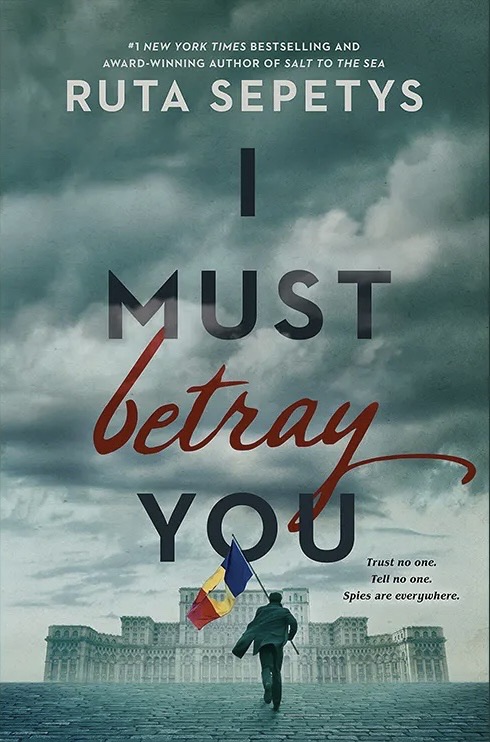
SYNOPSIS:
Romania, 1989. Communist regimes are crumbling across Europe. Seventeen-year-old Cristian Florescu dreams of becoming a writer, but Romanians aren’t free to dream; they are bound by rules and force.
Amidst the tyrannical dictatorship of Nicolae Ceaușescu in a country governed by isolation and fear, Cristian is blackmailed by the secret police to become an informer. He’s left with only two choices: betray everyone and everything he loves—or use his position to creatively undermine the most notoriously evil dictator in Eastern Europe.
Cristian risks everything to unmask the truth behind the regime, give voice to fellow Romanians, and expose to the world what is happening in his country. He eagerly joins the revolution to fight for change when the time arrives. But what is the cost of freedom?
A gut-wrenching, startling window into communist Romania and the citizen spy network that devastated a nation, from the number one New York Times best-selling, award-winning author of Salt to the Sea and Between Shades of Gray.
REVIEW:
My blood was trembling in my veins during this entire read. I’m familiar with Ruta Sepetys’ work, so when I found out that her next book is about the Romanian communism and revolution I didn’t know how to get it faster. I have no idea if her new novel will impress readers from other countries as much, but as a Romanian born during the communism, I have to take my hat off to the impressive work the writer has done. I’m in an awe that such a well documented book can be written by someone who not only is not Romanian, but had absolutely no previous connection to Romania until just a few years back. I can’t imagine how many years Ruta worked in order to aquire such amount of information, but the fact that there is a list of five (5!!) pages of sources at the end of the novel, gives you an idea about the amount of documentation needed in order to create such a realistic story.
It’s not just the romanian words that are thrown everywhere in the book. If the writer wouldn’t have used any, the impact would have been exactly the same. But every single description of the places, the atmosphere, the interactions or the feelings is literally screaming “Romania”. The book might not impress by the amount of shocking events. Or at least not until the last few chapters. But it builds such a dense tension that you can feel it covering your soul, your thoughts, just by recreating the normality of those years. The scepticism, the doubt, the constant feeling that you’re being watched and heard, the habit of always looking over your shoulder. The hunger, the darkness and the cold. The whispers, the suffocation. And over everything, the fear. The constant fear, the paralyzing fear that never goes away since you are a child and until you die. In you and in every single person around you. The fear becomes as normal and everlasting as your breathing, crushing your mind, your will, your dreams, your voice, bending you as a human being, bending an entire society.
Any revolution is a fight for freadom, a scream against suffering and distress. But what we often forget and what this book emphasizes is that a revolution is not only agains the system. It’s also against your deepest fears, agains your survival instinct that tells you to stay hidden, to stay safe, against your mother telling you not to go out, because outside it’s dangerous, against you leaving your friends in danger in order to go out there and confront an even greater danger. Because it’s not just about you, it’s about everything and everyone around you and all the generations following.
Between the pages of I Must Betray You are decades of pain that an entire country had suffered. Things that, depending on our age, we either lived or heard so much from our parents or grandparents that seem almost normal or unimpressive. For us, this is just how things were, that’s it. But for readers born in countries that were always free, for people unfamiliar with what communism meant, all our normality will look appalling. Ruta Sepetys doesn’t offer a history lesson. She literally takes you from your comfortable present and throws you in the past, in the middle of the history, living and feeling along with the characters inside the book.

