Posted in Ruta Sepetys

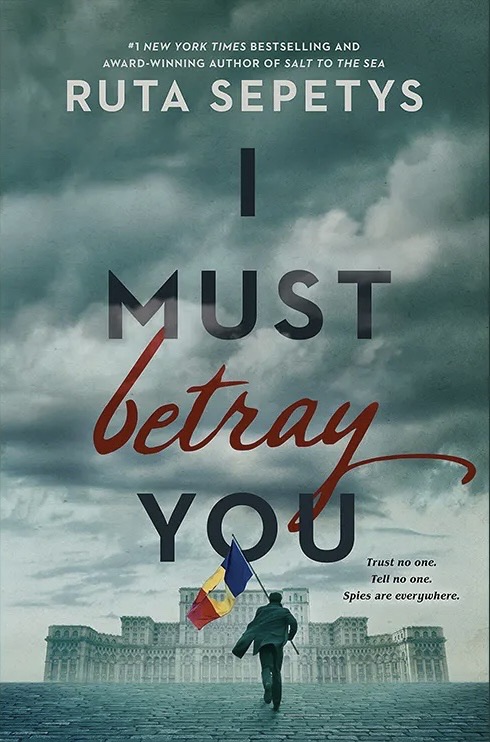
I Must Betray You by Ruta Sepetys

SYNOPSIS:

Romania, 1989. Communist regimes are crumbling across Europe. Seventeen-year-old Cristian Florescu dreams of becoming a writer, but Romanians aren’t free to dream; they are bound by rules and force.

Amidst the tyrannical dictatorship of Nicolae Ceaușescu in a country governed by isolation and fear, Cristian is blackmailed by the secret police to become an informer. He’s left with only two choices: betray everyone and everything he loves—or use his position to creatively undermine the most notoriously evil dictator in Eastern Europe.

Cristian risks everything to unmask the truth behind the regime, give voice to fellow Romanians, and expose to the world what is happening in his country. He eagerly joins the revolution to fight for change when the time arrives. But what is the cost of freedom?

A gut-wrenching, startling window into communist Romania and the citizen spy network that devastated a nation, from the number one New York Times best-selling, award-winning author of Salt to the Sea and Between Shades of Gray.

REVIEW:

My blood was trembling in my veins during this entire read. I’m familiar with Ruta Sepetys’ work, so when I found out that her next book is about the Romanian communism and revolution I didn’t know how to get it faster. I have no idea if her new novel will impress readers from other countries as much, but as a Romanian born during the communism, I have to take my hat off to the impressive work the writer has done. I’m in an awe that such a well documented book can be written by someone who not only is not Romanian, but had absolutely no previous connection to Romania until just a few years back. I can’t imagine how many years Ruta worked in order to aquire such amount of information, but the fact that there is a list of five (5!!) pages of sources at the end of the novel, gives you an idea about the amount of documentation needed in order to create such a realistic story.

It’s not just the romanian words that are thrown everywhere in the book. If the writer wouldn’t have used any, the impact would have been exactly the same. But every single description of the places, the atmosphere, the interactions or the feelings is literally screaming “Romania”. The book might not impress by the amount of shocking events. Or at least not until the last few chapters. But it builds such a dense tension that you can feel it covering your soul, your thoughts, just by recreating the normality of those years. The scepticism, the doubt, the constant feeling that you’re being watched and heard, the habit of always looking over your shoulder. The hunger, the darkness and the cold. The whispers, the suffocation. And over everything, the fear. The constant fear, the paralyzing fear that never goes away since you are a child and until you die. In you and in every single person around you. The fear becomes as normal and everlasting as your breathing, crushing your mind, your will, your dreams, your voice, bending you as a human being, bending an entire society.

Any revolution is a fight for freadom, a scream against suffering and distress. But what we often forget and what this book emphasizes is that a revolution is not only agains the system. It’s also against your deepest fears, agains your survival instinct that tells you to stay hidden, to stay safe, against your mother telling you not to go out, because outside it’s dangerous, against you leaving your friends in danger in order to go out there and confront an even greater danger. Because it’s not just about you, it’s about everything and everyone around you and all the generations following.

Between the pages of I Must Betray You are decades of pain that an entire country had suffered. Things that, depending on our age, we either lived or heard so much from our parents or grandparents that seem almost normal or unimpressive. For us, this is just how things were, that’s it. But for readers born in countries that were always free, for people unfamiliar with what communism meant, all our normality will look appalling. Ruta Sepetys doesn’t offer a history lesson. She literally takes you from your comfortable present and throws you in the past, in the middle of the history, living and feeling along with the characters inside the book.

Posted in Audrey Niffenegger

The Time Traveler’s Wife by Audrey Niffenegger

SYNOPSIS:

This is the extraordinary love story of Clare and Henry, who met when Clare was six and Henry was thirty-six, and were married when Clare was twenty-two and Henry was thirty. Impossible but true, because Henry suffers from a rare condition where his genetic clock periodically resets and he finds himself pulled suddenly into his past or future.

In the face of this force they can neither prevent nor control, Henry and Clare’s struggle to lead normal lives is both intensely moving and entirely unforgettable.

REVIEW:

I have a lot of feelings about this book but all of them are kind of floating in a pool of boredom. I believe the main reason for that is the fact that the book is so unnecessarily long and stuffed with details that don’t really contribute to anything. There are authors that have the talent to narrate even shopping list in an extremely captivating way. Unfortunately, for me, Audrey Niffenegger was very far from that. But putting this aside, the novel does have an intriguing side and that’s why I didn’t abandon it midway.

There is something unsettling about this book, especially the first half of it, when Clare is still young. Yes, the story is interesting, cute, funny (although sometimes the humor feels a bit forced) and sweet, but somewhere above all these nice feelings, you cannot stop feeling uneasy. Despite the fact that the characters are doing their very best to do everything morally right, something still feels wrong. You cannot exactly pinpoint how you would expect them to behave in such a situation. And I believe the author was very intentional for the readers to feel this way.

I loved the dinamic of knowledge between the two protagonists. Although you would expect Henry to be the only one with all the information – and in the beginning, everything seems to encourage this belief – later things switch to the exact opposite, for a period of time. It kind of makes sense, but it’s still a very unexpected twist.

I did like the fact that science gets to play a role in the story even if it doesn’t solve the mystery. But the fact that the protagonist looks for a medical explanation for his condition does offer a more realistic approach. Unlike some of the other aspects that are making it very hard to see the characters in a relatable way: the house full of servants, the unlimited flow of money, the artsy vibe of the protagonists. But still, those things are enabling the characters’ story so they were only mildly annoying.

I heard about this book for such a long time and was always curious about it, so I’m happy that I finally read it. But I am more happy now, that I’ve finally finished it than I was during the reading. And it’s never a great sign when a book feels more like a task.

Posted in Julie Clark

The Last Flight by Julie Clark

SYNOPSIS:

Two women. Two Flights. One last chance to disappear.

Claire Cook has a perfect life. Married to the scion of a political dynasty, with a Manhattan townhouse and a staff of ten, her surroundings are elegant, her days flawlessly choreographed, and her future auspicious. But behind closed doors, nothing is quite as it seems. That perfect husband has a temper that burns as bright as his promising political career, and he’s not above using his staff to track Claire’s every move, making sure she’s living up to his impossible standards. But what he doesn’t know is that Claire has worked for months on a plan to vanish.

A chance meeting in an airport bar brings her together with a woman whose circumstances seem equally dire. Together they make a last-minute decision to switch tickets — Claire taking Eva’s flight to Oakland, and Eva traveling to Puerto Rico as Claire. They believe the swap will give each of them the head start they need to begin again somewhere far away. But when the flight to Puerto Rico goes down, Claire realizes it’s no longer a head start but a new life. Cut off, out of options, with the news of her death about to explode in the media, Claire will assume Eva’s identity, and along with it, the secrets Eva fought so hard to keep hidden.

The Last Flight is the story of two women — both alone, both scared — and one agonizing decision that will change the trajectory of both of their lives.

REVIEW:

I just turned the last page of The Last Flight and I’m at a loss for words. I here declare my forever loyalty to this writer and promise to read every single book that she releases 🤩

10 pages into this book and my heart was already in my throat! Whaaaat a ride it has been! The whole book, every single page, every phrase buzzes with electricity, keeping your heart pounding and giving you permanent goosebumps. Even the recollections from the past, the side stories that should throw a wave of calmness and nostalgia don’t manage to dissolve for a second the tension and suspense.

And compared to most of the thrillers published in the last few years, the character’s portraits are anything but bland or stereotypical. I’m absolutely mesmerized by the depth of the two heroines’ personalities and how the author managed to merge the incredible tension with such profound backgrounds, detailed psychological features and intense and relevant message for the present days.

There is absolutely nothing missing from this book, nothing that feels missmatched or inaccurate. Every action, every trait, every step that either Claire or Eva take are deeply rooted in their past, from their childhoods to their recent years. I’m not even sure if some other readers will feel like some parts of the protagonists’ personalities have negative sides. Perhaps Eva might look too dark and too cold or Claire too paranoid and weak. But for me, the background given to them was so well depicted that makes it impossible to judge them even for a second or to feel like they would have had any other choices at any given time.

And over everything else, you can’t stop feeling their fear constantly, like a heavy blanket that covers everything they do, think or feel. Both Claire’s and Eva’s fear feels like a drowning moment on a loop, over and over again. Impossible to forget for even a moment, impossible to be completely free or relaxed even during the simplest activities. Whatever actions they take, whatever thoughts they have, they feel like gulps of air taken between desperate attempts to move, to survive. And yet, both of them find enough strength to fight, to find ways, to give themselves a chance to calculate the difference between reality and the paranoid thoughts seeded inside their minds by the constant terror.

I loved the side characters as well, how colorful they were sketched and how well the writer illustrates the impact of their choices over the lives of Claire and Eva. How a small gesture for someone can mean the world for someone else.

I don’t even know how to end this review, other than highly recommending it. I feel like nothing I could say gives enough justice to how intense the book is or to the way it will throw you on a roller coaster of emotions from the first to the last page.

Posted in Liane Moriarty

Nine Perfect Strangers by Liane Moriarty

SYNOPSIS:

Could ten days at a health resort really change you forever? These nine perfect strangers are about to find out…

Nine people gather at a remote health resort. Some are here to lose weight, some are here to get a reboot on life, some are here for reasons they can’t even admit to themselves. Amidst all of the luxury and pampering, the mindfulness and meditation, they know these ten days might involve some real work. But none of them could imagine just how challenging the next ten days are going to be.

Frances Welty, the formerly best-selling romantic novelist, arrives at Tranquillum House nursing a bad back, a broken heart, and an exquisitely painful paper cut. She’s immediately intrigued by her fellow guests. Most of them don’t look to be in need of a health resort at all. But the person that intrigues her most is the strange and charismatic owner/director of Tranquillum House. Could this person really have the answers Frances didn’t even know she was seeking? Should Frances put aside her doubts and immerse herself in everything Tranquillum House has to offer—or should she run while she still can? It’s not long before every guest at Tranquillum House is asking exactly the same question.

Combining all of the hallmarks that have made Liane Moriarty’s writing a go-to for anyone looking for wickedly smart, page-turning fiction that will make you laugh and gasp, Nine Perfect Strangers once again shows why she is a master of her craft.

REVIEW:

Some books just don’t give you that addiction feeling that doesn’t let you to put the book down until you don’t find out what happens next or until you’ve finished one more chapter. But in the same time, they are so cozy and comfortable to read that you wouldn’t mind if they would last forever.

This was the case for me with Nine Perfect Strangers. The book doesn’t have any wow factor, it’s not mind blowing in any way. Everything is balanced and mild: the drama, the characters, the mystery. But in the same time, slowly, with every page you read, you get attached to each one of the completely normal and non-spectacular characters, you want to find out more about their boring lives and just dive deeper into their minds. They’re all absolutely normal people, but they’re all nice and funny and the connection that forms between them creates the same pleasant atmosphere.

I’ve read other books from the same author and until now, Nine Perfect Strangers was the most superficial of them all. You know those thin commercial books that used to come when you were buying women magazines in the 90’s? This novel has the exact same vibe. Light, summer read that keeps you entertained enough but without leaving any marks in your memory once you’ve finished it. I wasn’t disappointed by reading it but it’s clearly not the book that I would enthusiastically talk about.

Posted in Margaret Atwood

The Handmaid’s Tale by Margaret Atwood

SYNOPSIS:

Offred is a Handmaid in the Republic of Gilead. She may leave the home of the Commander and his wife once a day to walk to food markets whose signs are now pictures instead of words because women are no longer allowed to read. She must lie on her back once a month and pray that the Commander makes her pregnant, because in an age of declining births, Offred and the other Handmaids are valued only if their ovaries are viable. Offred can remember the years before, when she lived and made love with her husband, Luke; when she played with and protected her daughter; when she had a job, money of her own, and access to knowledge. But all of that is gone now…

Funny, unexpected, horrifying, and altogether convincing, The Handmaid’s Tale is at once scathing satire, dire warning, and tour de force.

REVIEW:

As much as I wanted to read this book because of how famous it is, my first attempt was unsuccessful. I couldn’t get comfortable with the voice of the protagonist, nor with the writing style. Later, I failed to love the TV series because it’s such a slow burn and patience is not exactly one of my qualities. I can’t even remember how exactly did I decide to give the series another chance, but once I passed the first few episodes I became addicted. As a consequence, after finishing the last season, my wish to finish the book rose again and this time I didn’t feel any of the issues that I had before. The read was smooth and compelling. But to be honest, if I were to make a comparison between the novel and the series, the book feels more like a skeleton and the TV show gives the story full body and depth.

Although a dystopia and (fortunately!), still far and different from our present, I find it absolutely incredible how accurate and relevant the book is, especially since it’s been written more than 35 years ago. Compared to other dystopian worlds, which always have a feel of incredulity, The Handmaid’s Tale seems to be built on reality at such a chilling, high level that it becomes absolutely terrifying. There’s almost no aspect of it that feels like it wouldn’t become possible any day in the near future.

With few exceptions, globally we’re living probably at the highest peak of freedom that humanity saw since modern times. And yet, looking around, you can’t help but notice irregularities all over the world, you can’t help but worry that all this freedom is more fragile than we’d like it to be. And above all, the fact that the whole world has access to live information doesn’t seem to help in any way. No country will get involved in another one’s business, no matter how abusive a government would suddenly become. They all declare their worry and disapproval and urge the abusive authorities to reconsider their ways, but that’s about it. Some news and articles for a few days and then the world forgets. That is exactly why The Handmaid’s Tale feels so real. Because if anything like it would happen today anywhere in the world, that is exactly how things would develop. All our normality, all our freedom could be suddenly taken away and nobody would lift a finger to stop it. So no matter how shocking some events are in Atwood’s story, they still make sense, they still look plausible. I can’t wrap my mind around the way the author managed to create this concept and the more I think about it, the more amazed I am.

I didn’t give it 5 stars only because I am influenced by the complexity of the TV series and therefore, by comparison, the book leaves a lot of gaps that were filled by the information I had from the show. But I highly recommend the novel. It’s somehow slow and tells all the events with such a mild and resigned voice that it might mask the atrocity while you’re reading. But once you put down the book, all the ideas will start rolling and bubbling inside your mind, leaving you with a feeling of shock and uneasiness.