Posted in Gail Honeyman

Eleanor Oliphant Is Completely Fine by Gail Honeyman

SYNOPSIS:

Eleanor Oliphant leads a simple life. She wears the same clothes to work every day, eats the same meal deal for lunch every day and buys the same two bottles of vodka to drink everY weekend.

Eleanor Oliphant is happy. Nothing is missing from her carefully timetabled existence. Except, sometimes, everything…

REVIEW:

I had no idea about what to expect from Eleanor Oliphant Is Completely Fine. I knew the book made a lot of waves when it was published, but it didn’t exactly seem to be my cup of tea. I didn’t dislike it, I didn’t love it either, but I must admit that I’ve finished it way faster than I thought I would.

I feel like the author was indecisive and constantly oscillated between making Eleanor extra weird and making her very likeable in the same time. There’s a bit of trying too much in both directions, especially since the traits that he’s given her are quite opposite and tend to repel each other. There are also things that are so, so obviously not matching or making sense. For example, how Eleanor is such an avid reader, choosing not only fiction, but also completely random topics (like management, law or… pineapples), but she is so utterly clueless about simple things like social rules, internet, music, etc. This was especially more disturbing after I read that the author declared that no, Eleanor is not on the spectrum (which might have explained better a lot of her strange behaviours), but only suffering from depression. I did enjoy the narrative most of the time, but these disparities kept bugging me every now and then.

Overall, the storyline grows warmer and warmer as you read. It was lovely to witness such an array of lovely secondary characters, to see how encouraging and supportive they were and how Eleanor’s relationships evolved in time in such an optimistic and positive way.

I’ve read enough psychological thrillers in order not to be surprised by the twist at the end of the book. I’m not completely sure if it was intended as a bombshell, but I didn’t think it came much as a surprise. Despite that, it wasn’t disappointing at all. On the contrary, it felt more like a rational and consistent ending. Also, in line with that, I should mention that I loved the fact that the author chose not to turn the story into a romantic one. There are hints here and there, but I was happy to see an open ending and nothing clearly defined when it comes to Eleanor’s love life. This way, the story grows even more into one of personal healing on all plans, without focusing on love as the only solution for all the problems.
Posted in Ruta Sepetys

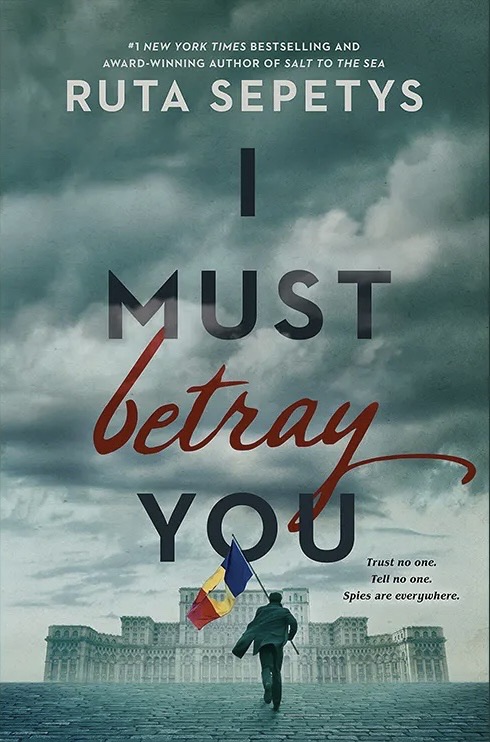
I Must Betray You by Ruta Sepetys

SYNOPSIS:

Romania, 1989. Communist regimes are crumbling across Europe. Seventeen-year-old Cristian Florescu dreams of becoming a writer, but Romanians aren’t free to dream; they are bound by rules and force.

Amidst the tyrannical dictatorship of Nicolae Ceaușescu in a country governed by isolation and fear, Cristian is blackmailed by the secret police to become an informer. He’s left with only two choices: betray everyone and everything he loves—or use his position to creatively undermine the most notoriously evil dictator in Eastern Europe.

Cristian risks everything to unmask the truth behind the regime, give voice to fellow Romanians, and expose to the world what is happening in his country. He eagerly joins the revolution to fight for change when the time arrives. But what is the cost of freedom?

A gut-wrenching, startling window into communist Romania and the citizen spy network that devastated a nation, from the number one New York Times best-selling, award-winning author of Salt to the Sea and Between Shades of Gray.

REVIEW:

My blood was trembling in my veins during this entire read. I’m familiar with Ruta Sepetys’ work, so when I found out that her next book is about the Romanian communism and revolution I didn’t know how to get it faster. I have no idea if her new novel will impress readers from other countries as much, but as a Romanian born during the communism, I have to take my hat off to the impressive work the writer has done. I’m in an awe that such a well documented book can be written by someone who not only is not Romanian, but had absolutely no previous connection to Romania until just a few years back. I can’t imagine how many years Ruta worked in order to aquire such amount of information, but the fact that there is a list of five (5!!) pages of sources at the end of the novel, gives you an idea about the amount of documentation needed in order to create such a realistic story.

It’s not just the romanian words that are thrown everywhere in the book. If the writer wouldn’t have used any, the impact would have been exactly the same. But every single description of the places, the atmosphere, the interactions or the feelings is literally screaming “Romania”. The book might not impress by the amount of shocking events. Or at least not until the last few chapters. But it builds such a dense tension that you can feel it covering your soul, your thoughts, just by recreating the normality of those years. The scepticism, the doubt, the constant feeling that you’re being watched and heard, the habit of always looking over your shoulder. The hunger, the darkness and the cold. The whispers, the suffocation. And over everything, the fear. The constant fear, the paralyzing fear that never goes away since you are a child and until you die. In you and in every single person around you. The fear becomes as normal and everlasting as your breathing, crushing your mind, your will, your dreams, your voice, bending you as a human being, bending an entire society.

Any revolution is a fight for freadom, a scream against suffering and distress. But what we often forget and what this book emphasizes is that a revolution is not only agains the system. It’s also against your deepest fears, agains your survival instinct that tells you to stay hidden, to stay safe, against your mother telling you not to go out, because outside it’s dangerous, against you leaving your friends in danger in order to go out there and confront an even greater danger. Because it’s not just about you, it’s about everything and everyone around you and all the generations following.

Between the pages of I Must Betray You are decades of pain that an entire country had suffered. Things that, depending on our age, we either lived or heard so much from our parents or grandparents that seem almost normal or unimpressive. For us, this is just how things were, that’s it. But for readers born in countries that were always free, for people unfamiliar with what communism meant, all our normality will look appalling. Ruta Sepetys doesn’t offer a history lesson. She literally takes you from your comfortable present and throws you in the past, in the middle of the history, living and feeling along with the characters inside the book.

Posted in Liane Moriarty

Nine Perfect Strangers by Liane Moriarty

SYNOPSIS:

Could ten days at a health resort really change you forever? These nine perfect strangers are about to find out…

Nine people gather at a remote health resort. Some are here to lose weight, some are here to get a reboot on life, some are here for reasons they can’t even admit to themselves. Amidst all of the luxury and pampering, the mindfulness and meditation, they know these ten days might involve some real work. But none of them could imagine just how challenging the next ten days are going to be.

Frances Welty, the formerly best-selling romantic novelist, arrives at Tranquillum House nursing a bad back, a broken heart, and an exquisitely painful paper cut. She’s immediately intrigued by her fellow guests. Most of them don’t look to be in need of a health resort at all. But the person that intrigues her most is the strange and charismatic owner/director of Tranquillum House. Could this person really have the answers Frances didn’t even know she was seeking? Should Frances put aside her doubts and immerse herself in everything Tranquillum House has to offer—or should she run while she still can? It’s not long before every guest at Tranquillum House is asking exactly the same question.

Combining all of the hallmarks that have made Liane Moriarty’s writing a go-to for anyone looking for wickedly smart, page-turning fiction that will make you laugh and gasp, Nine Perfect Strangers once again shows why she is a master of her craft.

REVIEW:

Some books just don’t give you that addiction feeling that doesn’t let you to put the book down until you don’t find out what happens next or until you’ve finished one more chapter. But in the same time, they are so cozy and comfortable to read that you wouldn’t mind if they would last forever.

This was the case for me with Nine Perfect Strangers. The book doesn’t have any wow factor, it’s not mind blowing in any way. Everything is balanced and mild: the drama, the characters, the mystery. But in the same time, slowly, with every page you read, you get attached to each one of the completely normal and non-spectacular characters, you want to find out more about their boring lives and just dive deeper into their minds. They’re all absolutely normal people, but they’re all nice and funny and the connection that forms between them creates the same pleasant atmosphere.

I’ve read other books from the same author and until now, Nine Perfect Strangers was the most superficial of them all. You know those thin commercial books that used to come when you were buying women magazines in the 90’s? This novel has the exact same vibe. Light, summer read that keeps you entertained enough but without leaving any marks in your memory once you’ve finished it. I wasn’t disappointed by reading it but it’s clearly not the book that I would enthusiastically talk about.

Posted in Frances Cha

If I Had Your Face by Frances Cha

SYNOPSIS:

A debut novel set in contemporary Seoul, Korea, about four young women making their way in a world defined by impossibly high standards of beauty, secret room salons catering to wealthy men, strict social hierarchies, and K-pop fan mania. “Even as a girl, I knew the only chance I had was to change my face… even before a fortune-teller told me so.” Kyuri is a beautiful woman with a hard-won job at a “room salon,” an exclusive bar where she entertains businessmen while they drink. Though she prides herself on her cold, clear-eyed approach to life, an impulsive mistake with a client may come to threaten her livelihood.

Her roomate, Miho, is a talented artist who grew up in an orphanage but won a scholarship to study art in New York. Returning to Korea after college, she finds herself in a precarious relationship with the super-wealthy heir to one of Korea’s biggest companies.

Down the hall in their apartment building lives Ara, a hair stylist for whom two preoccupations sustain her: obsession with a boy-band pop star, and a best friend who is saving up for the extreme plastic surgery that is commonplace.

And Wonna, one floor below, is a newlywed trying to get pregnant with a child that she and her husband have no idea how they can afford to raise and educate in the cutthroat economy.

Together, their stories tell a tale that’s seemingly unfamiliar, yet unmistakably universal in the way that their tentative friendships may have to be their saving grace.

REVIEW:

If I Had Your Face promises to allow you to dive in some of the most notorious trends that are “leaking” lately from the contemporary Korean culture into the international media: the plastic surgeries turned into a norm, the K-pop mania, the obsession with impossible beauty standards, the pressure of social hierarchies, the lack of balance between work and family life. Frances Cha manages to deliver an insight into these strict standards, showing how five young women struggle to live within all the restrictions imposed by the modern Korean society.

I was honestly expecting something a bit deeper, an explanation on how people are “digesting” all this pressure, an active reaction from the characters forced to submit to such unattainable ideals. Instead, all of the five women just… go with the flow, conforming to the cultural norms, without questioning or opposing them. I know it somehow makes sense, because… how unbearable life would be if you wouldn’t internalize the rules of the society around you? If the collective mentality wouldn’t become embedded into your core like it would be your own? But I still cannot help feeling unsatisfied by the fact that what we see is just acceptance and nothing of the process that’s shaping the personalities of the characters.

Despite this, I didn’t dislike the book. It’s mildly entertaining, like a little innocent gossip that you hear on the brunch with your girlfriends. Not bringing any depth or substance, but offering enough amusement. The book lacks on tension, even if there is a visible attempt to create some suspense here and there. But Frances Cha still manages to keep you reading without frustration. Honestly, if the author decided to write extra 500 pages about the same day-to-day casual experiences of her characters, I probably wouldn’t have minded or became bored of it.

The only problem I had with the book is that the characters’ voices are so similar. Even if every chapter has the name of each woman, I still struggled to recognize who’s story I’m reading. And this issue lasted until the very end of the novel, it was not something that faded by becoming more familiar with the particularities of each individual.

Posted in Celeste Ng

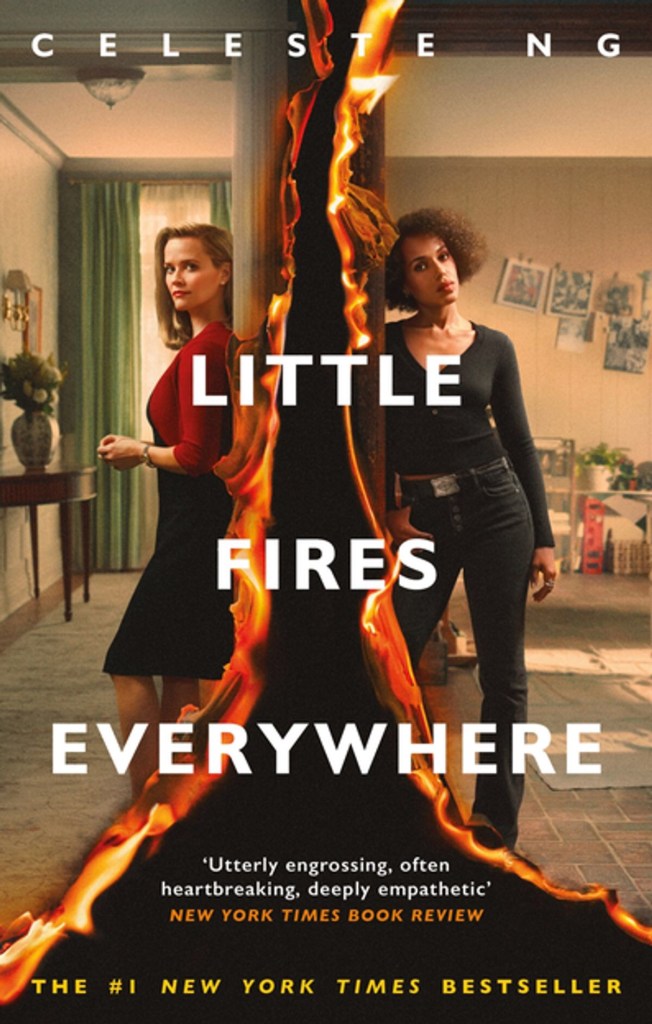
Little Fires Everywhere by Celeste Ng

SYNOPSIS:

From the bestselling author of Everything I Never Told You, a riveting novel that traces the intertwined fates of the picture-perfect Richardson family and the enigmatic mother and daughter who upend their lives.

In Shaker Heights, a placid, progressive suburb of Cleveland, everything is planned–from the layout of the winding roads, to the colors of the houses, to the successful lives its residents will go on to lead. And no one embodies this spirit more than Elena Richardson, whose guiding principle is playing by the rules.

Enter Mia Warren–an enigmatic artist and single mother–who arrives in this idyllic bubble with her teenaged daughter Pearl, and rents a house from the Richardsons. Soon Mia and Pearl become more than tenants: all four Richardson children are drawn to the mother-daughter pair. But Mia carries with her a mysterious past and a disregard for the status quo that threatens to upend this carefully ordered community.

When old family friends of the Richardsons attempt to adopt a Chinese-American baby, a custody battle erupts that dramatically divides the town–and puts Mia and Elena on opposing sides. Suspicious of Mia and her motives, Elena is determined to uncover the secrets in Mia’s past. But her obsession will come at unexpected and devastating costs.

Little Fires Everywhere explores the weight of secrets, the nature of art and identity, and the ferocious pull of motherhood–and the danger of believing that following the rules can avert disaster.

REVIEW:

I was not intending to read this book, but after watching the TV series, what eventually convinced me otherwise was the fact that… it seemed like my sympathies laid on the wrong side. Between the readers, there will always be Team A or Team B (remember Twilight?) but usually this happens when both options are reasonable and do not fall under the “villain” category. After watching the TV series, completely empathizing with Elena Richardson and almost hating Mia Warren, I discovered with shock that most of the people had a complete opposite opinion. Like.. Elena was the bad one?! Did we really watch the same thing?
So I started the book just to see if it will leave me with the same perspective or offer some additional details that might explain why most of the people had a different point of view.

Although you might expect the opposite when it comes to a book versus its adaptation, I felt like this time, the screenplay offered somehow an ampler spectrum of the main characters’ colors. In the book, Elena’s actions are clearly throwing her in the villain’s role, without giving too much depth to her reasons. By comparison, Mia’s lack of color makes you sympathetic to her cause without the justification of any actions, but simply because of the role she’s playing: the single, poor, but dignified mother that’s just trying to raise her daughter in the best way and… doesn’t really do much else.

In the TV series, my perception was different. Mia is selfish, sacrificing her daughter’s happiness and stability on the altar of her own career dreams. She stabs Elena in the back, she sets off a custody battle because of her own past trauma and without actually thinking about the well-being of the baby, she subtly manipulates and uses people around her. Yes, some of Elena’s actions are questionable as well, but only after she’s been provoked by Mia and usually have a “the end justifies the means” vibe. But overall, Elena just fights in a fairer way, with more direct hits. And even though her portrait might be simpler than Mia’s, who is this hipster-ish, gipsy-at-heart, mysterious and misunderstood artist, I stand by Elena’s cause. Although she sacrificed her own dreams for the sake of the family, I did love the fact that she had a strong attitude and turned the situation in the best way, without victimizing herself, despite having some regrets at an unconscious level. Meanwhile, Mia sacrifices everyone around her (her parents, the Ryan couple, Bebe Chow, the disputed baby, her own daugheter) for the sake of her own dreams and beliefs, without any doubts or remorse.

I also loved the portrayal of the other characters more in the TV series than in the book. All of the side characters and all of the kids’ experiences (both Pearl’s and the Richardsons’) are more lively and intense, you get to know them deeper and overall, the TV series just does it better. I feel like the book is covered by a veil that makes everything and everyone faded and blury, while the screenplay removed that veil and allowed the action to shine bright and colorful.